> For the complete documentation index, see [llms.txt](https://docs.reduxpayments.com/llms.txt). Markdown versions of documentation pages are available by appending `.md` to page URLs; this page is available as [Markdown](https://docs.reduxpayments.com/recovery-performance/why-do-i-need-redux-if-im-already-using-stripe-smart-retries.md).
# Why do I need Redux if i'm already using Stripe Smart Retries?
This is a question we get a lot, and for good reason. Stripe is a multi-billion dollar company. Haven't they solved failed payments already?
The answer is yes and no.
Stripe has built a product that works well for its 300,000 customers on Stripe Billing. It's good if you want generic recovery. But bad if you want to get the absolute most out of failed payments.
They recognize this which is why they partner with 3rd party solutions like Redux to boost recovery even further.
Here are 3 reasons you need Redux even if you're already using Stripe Smart Retries:
### **1) Redux is the top performing failed payments recovery engine for B2C subscriptions**
We're the only recovery platform on the market focused exclusively on B2C subscriptions. Stripe built their recovery to perform for B2B, B2C, Enterprise, etc... It's a broad good-enough solution.
But a B2B buyer with a corporate card needs to be recovered very differently than a B2C consumer. This nuance is completely ignored with basic recovery.
We train our AI models exclusively on consumer behavior and banking patterns. Our obsessive focus allows us to recover B2C subscriptions better than anyone else.
***
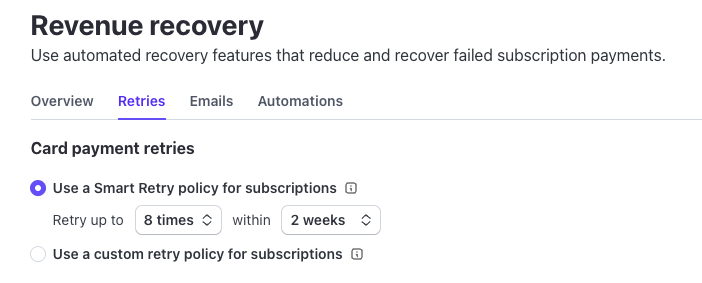
### **2)** Stripe caps you at 8 retries, Redux let's you **go further**
Stripe caps you at 8 retries. But that's not what the best consumer subscription companies on the planet do.
Hulu, for example, will retry a payment up to [13 times over a 50 day period](https://www.linkedin.com/posts/philip-pages-a881b5139_if-you-want-to-witness-absolutely-shameless-activity-7383521354836496385-U7c0/).
But just spamming 13 retries and calling a day is terrible practice. The key is to retry intelligently when your customer has funds in their account or when banks are more likely to approve transactions. It's a balance you need to get right.
The key is to recover a failed payment in as few retry attempts as possible. But you should have the option to retry more over a longer period if that means you can recover that transaction safely.
Redux intelligently retries your B2C failed payments when they're most likely to go through and prevents you from being capped by Stripe's 8 attempt limit.
***
### **3) Stripe sends too many emails which increases churn**
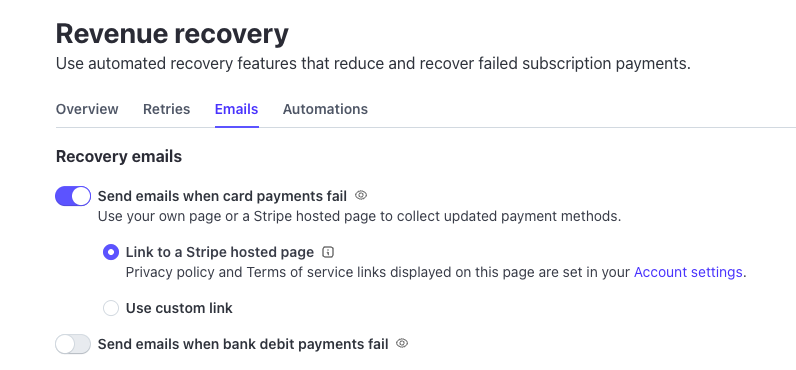
For every retry attempt, Stripe will send a recovery email. So if you do 8 retry attempts, customers will get blasted with 8 identical generic emails. This trains your customers to ignore future messages and is known to increase voluntary churn.
Not great if you're trying to build a better relationship with your customers.
Our team comes from the consumer world. Having previously built and exited a consumer startup, we know how important every customer touch point.
That's why we handle communication differently.
Just like with retries, less is more.
Recovery emails use Smart Sending to optimize send times for when your customers are most likely to open and click. They also send from your domain and use your branding.
The goal should be to help build a better relationship with your customers while helping them fix their payment. Not spam them into submission.